
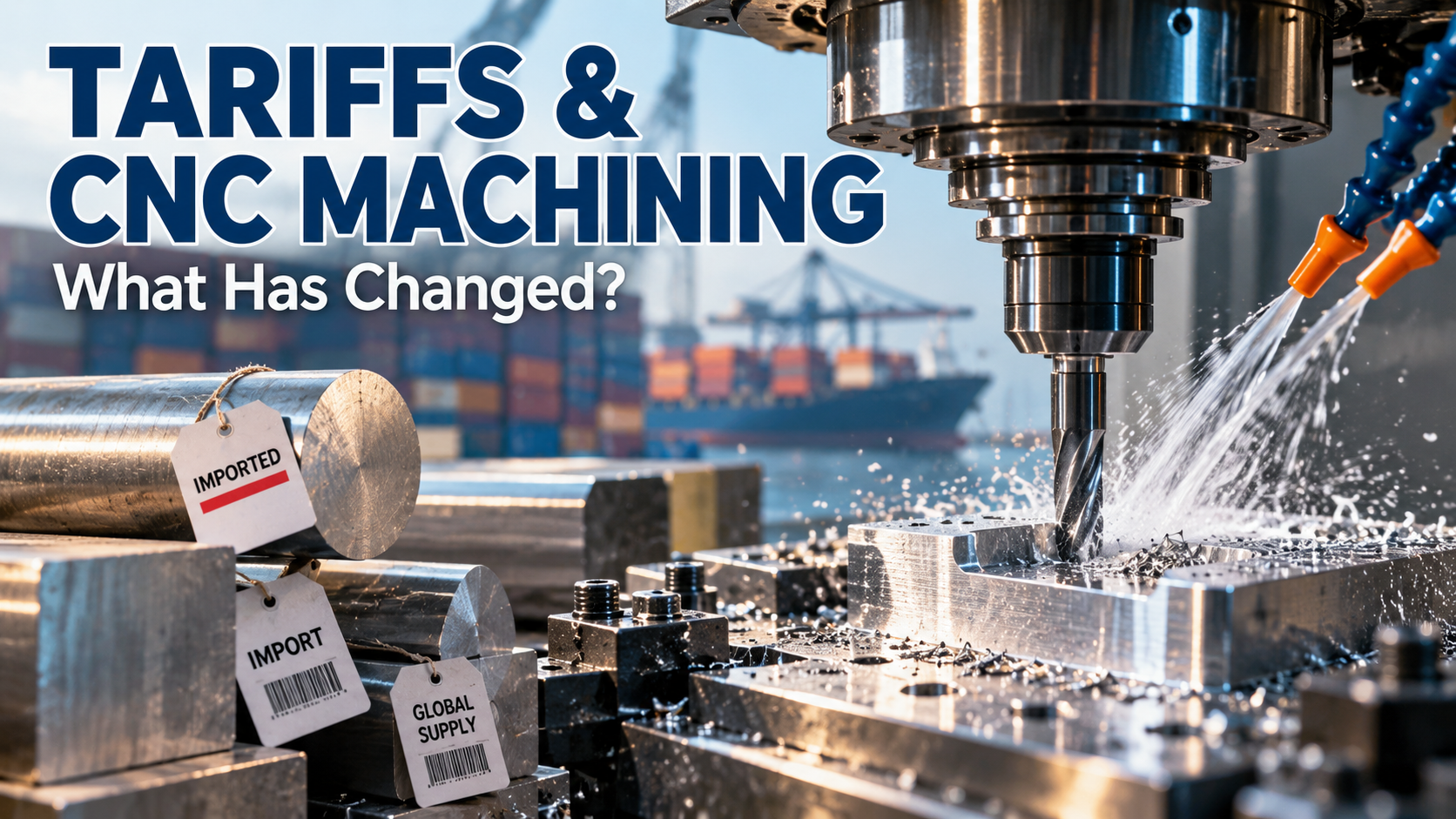
Tariffs have become another important variable manufacturers must account for when quoting work, purchasing material, investing in equipment, and planning their supply chains. For CNC machine shops, however, their effects are not straightforward. Tariffs can make imported parts more expensive and encourage manufacturers to look for domestic suppliers, while American machine shops themselves purchase steel, aluminum, cutting tools, machinery, and other inputs whose costs can also be affected by tariffs. As a result, a U.S. machine shop can benefit from increased interest in domestic sourcing while simultaneously dealing with higher costs of its own.
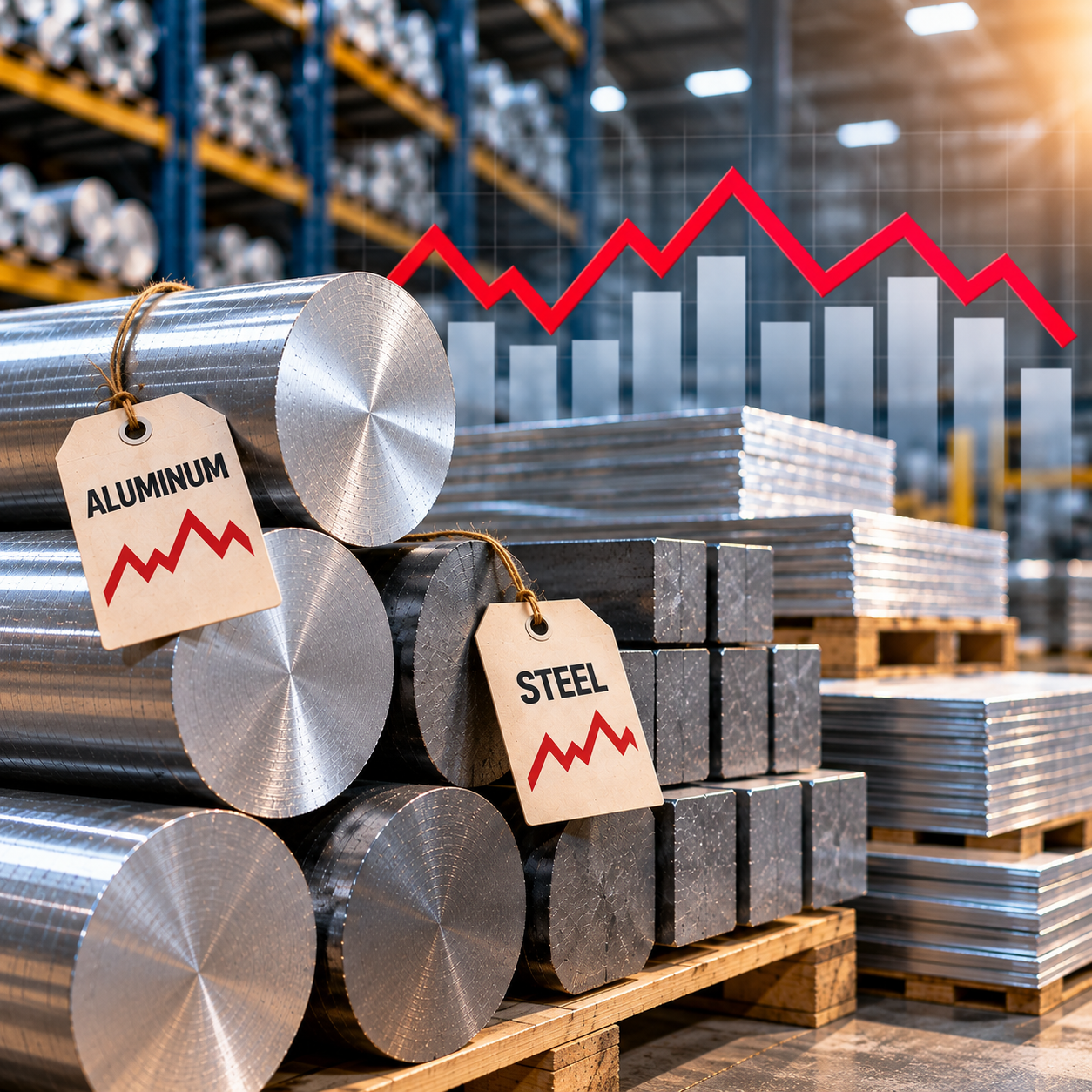
Steel and aluminum are fundamental inputs for manufacturing, so changes in their cost eventually work their way through the supply chain. Historical analysis by the U.S. International Trade Commission found that Section 232 tariffs reduced imports and increased U.S. production of both steel and aluminum, but also increased U.S. prices for those metals. The Commission found that downstream manufacturers using steel and aluminum experienced higher prices and, on average, lower production as a result.
Those cost pressures remain important to manufacturers today. In the National Association of Manufacturers' second-quarter 2026 survey, 83.1% of manufacturers identified rising raw-material costs as a business challenge, while 71.8% cited trade uncertainty. Respondents expected raw-material and other input costs to increase 5.8% over the following 12 months.
For a CNC shop, these changes matter every time we prepare a quote because the price of a machined part is made up of much more than machine time. Material, tooling, setup, inspection, labor, overhead, and outside services all contribute to the finished cost. When those inputs change rapidly, quoting becomes more difficult, particularly on jobs that may not enter production immediately or on long-running programs for which customers expect stable pricing.
The effects are not limited to raw material. Modern CNC manufacturing depends on machine tools, cutting tools, workholding, automation, replacement components, and other equipment sourced through global supply chains. The National Tooling & Machining Association has identified tooling, automatic tool changers, grinders, lathes, and CNC machines among the investments that can be affected by changing tariff policy. In 2025, certain imported machining centers were also added to products affected by Section 232 steel and aluminum tariffs.
These costs matter because machine tools are long-term investments. A precision CNC machine purchased today may be expected to produce parts for many years, and its acquisition and financing costs ultimately become part of the cost of operating the shop. Higher prices for equipment, tooling, replacement parts, or automation therefore can affect manufacturers long after an individual tariff change takes effect.

At the same time, tariffs can create opportunities for American CNC shops. When an imported component becomes more expensive, the difference between an overseas quotation and a domestic quotation can shrink. That does not necessarily make domestic manufacturing the least expensive choice in every situation, but it can change the calculation enough to justify taking another look at U.S. suppliers.
Piece price is only part of that calculation. Overseas sourcing can also involve freight, longer lead times, larger minimum quantities, increased inventory requirements, communication delays, and greater difficulty responding quickly when a drawing changes or a part fails to meet specifications. The National Tooling & Machining Association has encouraged U.S. manufacturers to consider the current trade environment as an opportunity to promote domestic sourcing and reshoring. For buyers, that means it may be useful to compare the total cost and risk of sourcing rather than simply comparing the prices printed on two quotations. For a closer look, read The Hidden Costs of Choosing a CNC Supplier Based on Price Alone.
Recent experience has also demonstrated how difficult it can be to recreate an established manufacturing supply chain simply by moving production from one low-cost country to another. Reuters reported in September 2026 that some companies that moved sourcing out of China in response to tariffs later returned some production there after encountering problems replicating China's supplier networks, equipment availability, skilled labor, and infrastructure elsewhere. The experience illustrates that a mature manufacturing supply chain provides capabilities that cannot always be duplicated quickly simply by selecting a different country with lower labor costs.
That lesson applies on a smaller scale to the sourcing of precision-machined components as well. A reliable supplier relationship has value, particularly when a part is complex, critical, or difficult to manufacture consistently. For these components, the lowest piece price may not represent the lowest overall cost if it comes with increased risk of late delivery, inconsistent quality, excessive inventory, poor communication, or difficulty responding to engineering changes.
For engineers and purchasing professionals, the changing trade environment makes this a good time to reconsider how machining suppliers are evaluated. Price will always matter, but it should be considered alongside quality, lead time, transportation, inventory requirements, communication, delivery reliability, and the ability to respond when something changes. A small saving on an individual component can disappear quickly if a delayed shipment or rejected part holds up a much more expensive assembly.
A domestic CNC partner can offer advantages that do not always appear as separate lines on a quotation. Shorter communication loops, easier engineering collaboration, faster response to problems, reduced transportation exposure, and greater visibility into production can all have economic value. Those advantages become particularly important for small, complex, or critical components where the cost of the individual part may be modest compared with the cost of having the entire project delayed because that part is unavailable.
At Adept Manufacturing & Gauging, we specialize in precision CNC machining, particularly smaller, complex components that can create surprisingly large manufacturing challenges. We are not going to tell customers that domestic manufacturing is automatically the right answer for every component, because sometimes it isn't. What tariffs and recent supply-chain disruptions have demonstrated, however, is the importance of considering the entire sourcing equation rather than relying on piece price alone.
Price matters, but so do quality, lead time, communication, delivery reliability, and risk. When all of those factors are considered together, a capable American machine shop may be considerably more competitive than the initial price comparison suggests. If tariffs or supply-chain uncertainty have you reconsidering where your precision components are manufactured, it may be worth getting a domestic quote and comparing the complete cost of the two alternatives. Sometimes the biggest surprise isn't how much American manufacturing costs; it's how competitive it has become.